

The Unlink of Electromagnetic Waves

I’ve been sitting on this post for quite some time. Not because I wouldn’t have a lot to say, but exactly because I am so close to finalizing the basic theory of everything that saying anything before being 100 % sure becomes a challenge. In my last post, the clunkily named “The Wavelength – Central Angle Correlation of Light” I said
However, much before this point, the assumption that one can ignore the forward dimension has broken. For the entangled helix to be able to move properly, each turn must be at a slight angle, giving it some depth in the forward dimension, even when moving in vacuum (with no external refractive index). I think when I take the third spatial dimension into account, I will probably understand much more.
And this is what I did: I added the third spatial dimension and found out something peculiar. At first, I was confident that the motion of light is comprised of a brief period of free motion, followed by a period of curved motion, as illustrated especially in the post “The Nobel Motion of Light” and partially in the post “A Vibrating Polygon of Branes”. But upon closer inspection this idea of free motion in one region and bound motion in another region didn’t seem fully accurate. Basically, if the motion is truly linear and free half of the time, the helix could not be comprised of two helices encircling a common center, located at the edges of the helices. Rather, in this case the linear helix would be at the center, with radius of its own helix being zero, and its neighboring helix would rotate around it, with a radius of 2r (or the diameter of the spheres that make up the helix). But when I added the third dimension, this model didn’t seem to make as much sense, at least for a freely moving helix. The combination of these elements would introduce a curvature that would force the particles into an orbit around a spherical volume. This would turn light into a quasi-particle. So, I think the model isn’t wrong but doesn’t depict the wave-state of the free motion of light.
So, it was back to the drawing board for the free motion of light. I had plenty of interesting ideas for the motion of light, but somehow whenever I poked a bit harder, the motion always transitioned to the linear state, where there was no rotational component. I.e. light in a vacuum always moves in a straight line with no diffraction. After just staring at my Blender model for hours and trying to tweak parameters to gain some insight, a flash of insight struck me. What if light was an unknot? I had toyed with the idea of unknots in my previous post “Proton is an Unknot”, already two and half years ago and wrote three posts with the term unknot in the title. I even turned the geometry into equations and submitted my first manuscript on the theory of everything presenting the geometry. But the manuscript was desk-rejected (if I recall correctly), so I never specifically learned why it wasn’t even good enough for peer review. Except I understand now: the theory wasn’t bottom-up enough.
While my literal and figurative twisting and turning of the theory showed that light is an unknot, it also showed that light is not just an unknot, but also an unlink. According to Wikipedia:
In the mathematical field of knot theory, an unlink is a link that is equivalent (under ambient isotopy) to finitely many disjoint circles in the plane.
The two-component unlink, consisting of two non-interlinked unknots, is the simplest possible unlink.
The Wikipedia article gives two unjoined rings as an example:

So, how does one twist these two rings into an electromagnetic wave/particle? Well, first I checked with Blender, whether it’s even possible to get the desired shape and I managed to make a rather complicated shape, with helices. But upon closer inspection, the shape looked too complicated. The reason being that inspired by the first shape, I tried to replicate it with two looped pieces of string, and I managed to make a nice twisted unlink with a much simpler method.
The shape that I made is something that you, dear reader, can replicate as well. First, make sure that the loops are pretty much the same length. Then place them somewhere where the loops retain their general shape, even if you manipulate them a bit. I made my loops so large that I could put my legs through the pair of loops and pull them apart to tighten the loops. Then I placed a pen between the two loops and started twisting the pen around, forming a counterclockwise/clockwise pair of turn with each full rotation. And even though I only rotate one point in the pair of loops, these turns eventually propagate through the entire pair, eventually reaching the opposite side.
And the shape I got looked like this:
Okay, you might say: “you’ve been able to make the shape above with your own hands, but why would it in any way represent light?” My answer is a slightly unsatisfactory “my intuition says so”. My theory thus far states that the motion of light would be logical, if it was made up of one half of such a pair of helical loops. But what would happen to the other half? Well, here I found inspiration from what is known of electromagnetic radiation. You see, light is comprised of both an electric field and a magnetic field:
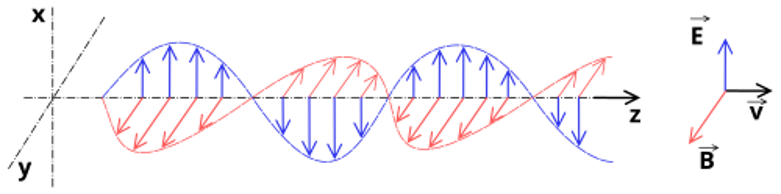
This means that upon the generation of light, two types of fields are generated. This matches with the generation of the clockwise and counterclockwise helices of elementary particles, at least to the degree understand light.
But for the two parts of the helices to move as waves, they must be separated. The helices must detach from both ends, so they can rotate in the opposite directions. And for light to be a particle and interact with matter, these two helices must join. However, this is where my ignorance catches up with my intuition. What happens next is yet unknown to me.
Perhaps I can turn these insights already into a manuscript, but I’m not 100 % certain. It seems I would still like some mathematical certainty about how the rotational motion propagates like a wave via inter-elementary-particle reflections. Certainly, if I’m able to do this, I can’t see how the manuscript wouldn’t at least be accepted for peer review.
However, I’ll mull the theory for at least a bit until I make the decision whether or not to settle with this interpretation. I don’t see any obvious flaws in it, but that doesn’t automatically mean that it has no flaws.
Comments