

The Wavelength – Central Angle Correlation of Light

My post for today is my first step in applying mathematics to the structure of light, based on the (hopefully) correct geometry I introduced in my last post “The Nobel Motion of Light”. At first I thought that I had realized something more fundamental, but as I dug deeper, I realized I had only figured out the basics, because I’m working on a 2D projection of a 4D object (a 3D object in space, with time added as the 4th dimension). But despite these limitations, I did find something cool.
So, what did I find? Before I can do the "big reveal", let’s get back to basics. First of all, we know that the energy of a photon follows the Planck relation, or E = hc/λ, where h = Planck constant, c = speed of light and λ = the wavelength of light. This has been proven without a doubt, so whatever I find out, cannot be in contradiction with the Planck relation. And as the Planck relation clearly shows that energy is inversely proportional to the diameter (wavelength) of light, the wavelength cannot be the only defining characteristic of a quantum of light (photon).
Before we can go deeper into mathematics, we need to ask the question: “what is a photon?”. My running hypothesis is that photon must be a single turn of an entangled helix of the elementary particles (that make up both light and matter). And based on my last post, half of the turn looks like an arc in the y-z projection, and half looks like an arc. This means that light in vacuum is to some extent both a circle and a polygon, at least when viewed perpendicular to its direction of motion.
This means that we can treat the properties of light as a simple geometrical calculation. Firstly, the turn is split into two parts. In one part the helical segment is linear and in the other segment it’s arced. For now, we can ignore all but one particle in the arced segment and focus on the linear segment. The linear segment forms an equilateral triangle with the center of the y-z projection of the total helix of light, with the equal sides having a length of λ/2 and the third side having a length of nLp, where n is the number of particles in the segment and Lp the diameter of an individual particle (shown in the scheme below). I’ve chosen Lp as its symbol, as I assume (until proven otherwise that the particle has a diameter of Planck length, Lp). I’m still fully expecting to be shown that the length is not exactly Lp, but Lp multiplied or divided by either a constant (such as π), or an integer (or its square root). And the height of the triangle, when stood on its third side, is λ/2- Lp. And the final element that pops out of this chart is the (unknown) angle α of the circular arc that it the pair of this triangle.
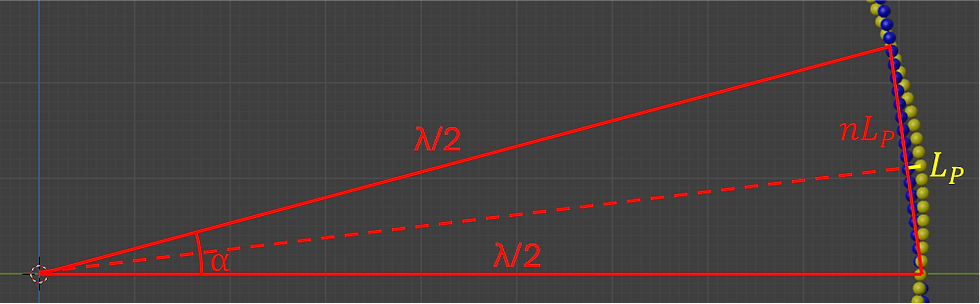
And here comes the math. Assuming we know λ and Lp, we can derive from the above scheme that

While the arccos form is more intuitive, I can’t use it in Excel, because the value in brackets is too close to 1, which prevents me from using Excel in my calculations (because Excel rounds the value to 1). The arcsin form uses an arcsin of a very small number, which Excel doesn’t round down to zero. In fact the arcsin form can be simplified to arcsin (x) = x, with small numbers, the ratio of Lp to λ is sufficiently small that the results are identical to the 30th decimal down to a wavelength of 0.000000000000000000001 m (1E-21 m), which is orders of smaller than the smallest gamma ray and right there down to the experimental limit of size detection of the size of an electron (although here I might misunderstand what Wikipedia says about the electron, so take this with a pinch of salt)
Once we have α, we can figure out what integer n is. While the above scheme would lead one to believe that we already knew n, there is never a true situation where we can actually see individual particle. Rather, n must be calculated from the known numbers. Firstly, the length of the third side (L) is:

Thus, we get

This can be rewritten as

Which is the exact relation of the number of particles in a half-turn of one helix (of a pair of helices) with the wavelength of light. It is probably pointless to ask why this is. It’s just what it is, according to mathematics.
When we plop this into the Planck relation, we get

And as

Where G is the gravitational constant. We get

And what does this mean? It probably means that I’m still missing a crucial piece. If a square of the number of particles in a single turn of the double helix is inversely proportional to the energy of the double helix, this gives me the feeling that perhaps a single turn of a helix isn’t a photon after all. However, it is still possible that a single turn of the helix is a photon. The reason for this comes from Neil Degrasse Tyson: “The universe is under no obligation to make sense to you.” But at this very moment I just couldn’t say either way.
Perhaps the question itself about what a single photon is, is wrong. If light is a circular entangled helix, the energy absorbed by an object might have as much to do with its environment. Perhaps light is indeed absorbed be several objects (such as molecules) at a time, where the energy attributed to the light is only the fraction allotted to a single object (molecule), as was my idea four and a half years ago. In this case the question of what the energy of a photon is, is mostly a mathematical ‘trick’. Rather, in this case how much energy light can give to a single molecule is dependent on the angle of the arc of a single turn.
But we don’t need to be fully despondent about the tangibility of the theory. If we plot α as a function of λ according to:
we get this curve:

The plot says that if the wavelength of light is reduced sufficiently, the angle of a circular arc is increased closer and closer to a full circle (2π). Specifically at λ = 2 Lp the arc angle is π, which is geometrically already nonsensical, because the circle is reduced to a digon, or a polygon with two sides. However, at this point the length of a single turn is Lp, which means that there is actually no space for a digon.
However, much before this point, the assumption that one can ignore the forward dimension has broken. For the entangled helix to be able to move properly, each turn must be at a slight angle, giving it some depth in the forward dimension, even when moving in vacuum (with no external refractive index). I think when I take the third spatial dimension into account, I will probably understand much more.
Also, a reveal: I was about to call this post “E = (nLc)² and the Elementary Particle of Momentum”. But I had to scrap it for two reasons. Obviously, the equation above isn’t at all what I thought at the beginning. And secondly, the equation led me to believe that the elementary particle I’ve been working on isn’t a particle of energy, because there appears to be no linear correlation of the particle with its energy. But I thought it still had a positive correlation with the momentum of light. However, I’m not sure about that either.
But surely that wasn’t the “big reveal”, was it? Well, I guess when I started this post, I thought I would have a bigger reveal than I actually do. To some extent the fact that I can apply my model and get real-life correlations is the big reveal. And the fact that I can correlate physical objects with energy is a beginning. But correlation isn’t causation. I don’t know why energy is correlated with my particles in the way my equations describe. Once again, this is more of a teaser post. Possibly when I introduce the third dimension, I already learn a bit more. And probably when I add the time dimension, things are gradually beginning to make more sense.
The only thing I can say, once again, is “watch this space”.
Comments