

A Vibrating Polygon of Branes

In my last post, Entangled Rotating Branes, I showed an animated model for the rotating motion of entangled helices of branes (toroidal arrays of elementary particles of energy). With the settings that I chose, the shape looked aesthetically pleasing, but somehow impossible. In today’s post I take the same model but adjust settings to illustrate more realistic motion of the particles.
The main problem with the previous illustration was that I chose the dimensions for the most visually striking model. This meant that the minor radius of the entangled torus was relatively close to the minor radius, which led to the shape showing bulges at each entangled rotation (or knot). This leads one to assume that there would be an actual force from the center of the entangled torus pulling the branes inwards. Naturally this isn’t what is happening.
Rather, here we should look at Newton’s first law of motion:
A body remains at rest, or in motion at a constant speed in a straight line, unless it is acted upon by a force.
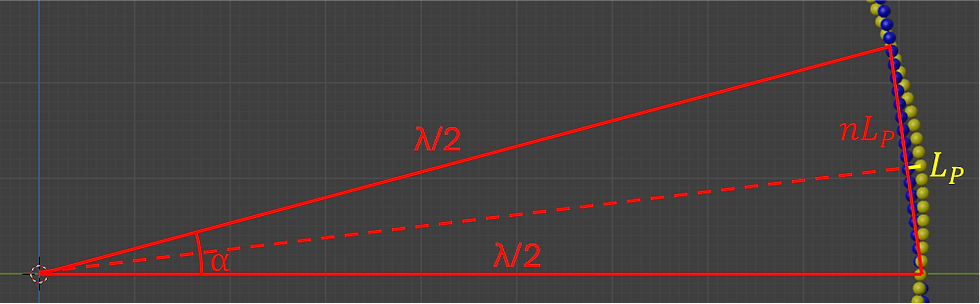
This means that the shape must be formed from particle moving in straight lines and any change in the geometry must be derived from Newton’s first law. Simply put, any circular motion (at least on the self-driven scale) should be considered a quasi-polygonal motion, made of three-dimensional helices. And these helices have such a small radius that the bending of the entangled helix no longer looks like a conventional helix, but a rounded polygon. In practice, this means that the general motion of the helix is mostly linear for a significant part of the rotational turn, at least with small number of turns, but the motion is arced at the intersection of two neighboring linear sections. This is how it looks like in an example that I specifically built to illustrate the polygonal state, where one can still see individual spheres:
From the shape one sees that the entangled helical polygons are otherwise identical but offset by an angle relating to the number of edges in the polygon. And of course, the way these two polygons don’t overlap is that the helical shape makes the polygons undulate perpendicular to the plane of the circle (or torus, to be more specific). Thus, the highest point of the undulation of one helical polygon overlaps with the lowest point of the undulation of its neighbor.
This actually explains the nature light. When the small radius of the helix is constant, the only way to form a large circle is to have a huge number of turns, with the length of the helix being small. This corresponds with light with a large wavelength but a small energy in a single photon (one turn of the helix). But the smaller the radius of the circle, the longer the absolute length of a single turn. Or this is my intuition when I look at the shape. I can’t exactly prove this yet
And the vibration? Well, this hasn’t changed (much) from my previous posts. The vibration is primarily caused by the elastic collisions of the elementary particles of energy from its neighbors. But there is also the vibrational component of the two helices colliding. But if I understand correctly, there is only one such vibration per turn. And only in the strand of the helix in direct contact with the neighboring strand. You might ask, is this reflected in the above animation. The short answer is, no. The reason is that for light, the radius of the arc between collisions is so infinitesimally small that one cannot show this in model that shows both the circle and the particles. You either end up showing an incredibly thin circle with no way of seeing an individual particle, or you end up zooming so much, that the arc looks like a straight line. I might be able to illustrate the thinness of the of shape, but only by retaining a minor radius that is way too thick for physical realism. But there is a small chance that I might be able to illustrate the rotating motion brough about by the collision of neighboring helices. This might be an easy task, or a fiendishly hard one. I will only know which it is when I’ve tried.
A very curious realization relating to this shape is that it looks awfully close to the way the value of π is defined. Who knew π might be so closely linked to the elementary particle of energy.
Finally, I must emphasize that while I’m talking about the elementary particle of energy in this post, I’m still not sure whether light is a close, or an open brane. I seem to be constantly switching my opinion, as I tackle its mathematics. I’m happy to let mathematics finally show which option makes more physical sense. The framework is already strong enough that I’m quite confident that I know what sufficient proof is when I see it. Before that I will just build my model and correct it when I encounter obvious errors. In the meanwhile I need to be content with models that are obviously incomplete
Comments