

A Vibrating Circle of Light

I’ve been talking about the nature of light in several of my previous posts, such as in The Definitive Particle-Wave. And I’ve had a bunch of ideas on the exact nature of light. While I’m pretty much 100 % certain it consists of elementary particles of energy, its actual shape in motion and its specific motion have eluded me. Whenever I’ve thought I’ve had an epiphany on it, on later inspection I’ve realized some serious flaws. But today’s post might be different. I might just have cracked the code of light.
I wasn’t really even trying to, but while I was figuring out the difference between rotating and vibrating bodies, the idea crept to me that this is relevant to light as well. Basically, only a liquid can rotate, as is has sufficient inertia to keep rotating. A solid vibrates, as its inertia cannot sustain the motion, but rather the rotational motion is reflected back and forth. This led me to ask: “What is more probable? Does light rotate or does it vibrate?”. My intuition says that based on everything that I’ve learned during these years of study, light cannot rotate, as the motion of individual particles of energy are governed by reflections and reflections in circular arrays of particles leads to vibrations.
But to be honest, this wasn’t just about intuition. I was modeling the helical motion of arrays of spheres, following the The Definitive Particle-Wave model, with the physics tools in Blender. And after hours of struggle, I finally got Blender to do what I wanted, but what I saw wasn’t exactly what I had anticipated. When I introduced rotational motion to the arrays of particles, with the idea that one half-helix would be rotating in one direction and the other half-helix would be rotating in another direction, the model didn’t ‘like’ this at all and the spheres just started vibrating between its neighbors and then flew gradually so far apart, that there would be no more collisions.
For a short time, I entertained the thought that this was just a flaw in Blender and that spheres of energy would behave better, but when I started thinking of the possible mechanism by which there could be rotation in an externally mostly uncontained circular array, I just couldn’t think of any.
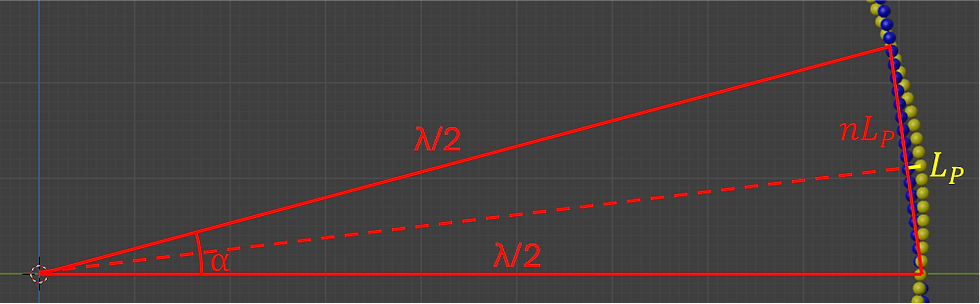
This led me back to an idea that I had had some time ago, but which I’m not sure whether I ever posted on. This is the idea that light is circle of multiple photon-waves. The reason for this comes from the knowledge that the higher the energy of a single photon is, the smaller the wavelength of light. This means that for light to have both a large wavelength and a small energy, the circle of elementary particles of energy must be divided into multiple photons. For some time, I thought that this was just an abstraction and that the photons are just a mathematical trick, explaining the amount of energy absorbed by a single molecule in a supramolecular array. But at least as far as I understand, the experimental data on photons doesn’t back up this abstraction argument. However, if a photon was a literal sine wave of particles, the circular array would be true circle in vacuum but compressed into a circular sine wave in a medium with a refractive index higher than one.
What had stumped me before was the idea that I couldn’t imagine how these sine waves could be made to rotate. And because of this, I just buried the idea. But now that I realized that vibration is a completely acceptable state of being, I thought that this resolved many problems at once. I could have small photons in a large wavelength of light, and large photons in a small wavelength. And I could have concrete wave-particle duality.
And this is the basic idea what light coming from a light source ‘looks like’ (figuratively, of course):
I still don’t know whether this idea holds, or whether it has some major flaws that I have no idea about. I have a good feeling about it, but it could be just my ignorance about all the experiments that are in direct contradiction with the idea. But if I was a betting man, I might even hazard a smallish bet on me being right. But small enough that it won’t sting too much if I’m proven wrong…
Comments