

The Definitive Particle-Wave

In several of my previous posts I´ve talked about the nature of light. In fact, I might even say that having an epiphany on the nature of light is what initially led me to try to develop the theory of everything. I´ve known the simplified model of light for more than four years now. And the simplified model is a ring of elementary particles of energy. But what I haven´t understood is how these rings move.
More precisely, in the beginning I had a mathematical idea of how light could move, knowing how the propagation of light in a medium with an index of refraction of light slows it down. In this model, light in a vacuum was a ring of particles moving as a unified front, perpendicular to the ring. In the same model, if the motion of the ring was confined, it would elongate into a helix that would move like an inverse cork-screw.

While this model was mathematically reasonable, it had a major physical flaw: how could the closed-loop ring form an open-ended helix?
Well, the answer is, the ring doesn´t need to open. Rather, if the helical shape above is converted into a petal-shape, made of two half-helices, this shape can move as an identical rotating front as in the above model. Like this:
I actually had come up with this idea quite a while ago, but just by itself, the model didn´t seem complete. There was still the problem of how this rather simple helical model translates to the motion of entangled helices: the basic structure observed in supramolecular motion.
I´ve shown the below picture several times before. In it, you both see arrays of particles entangling a half-circle (picture b) and entangling a half-helix (picture a): i.e. both cases relevant for the motion of a circular wave. But as you see from the below model, the motion I show there is tangential to the helix. What will happen if you close the half-circle/half-helix pair into a single entangled circle?

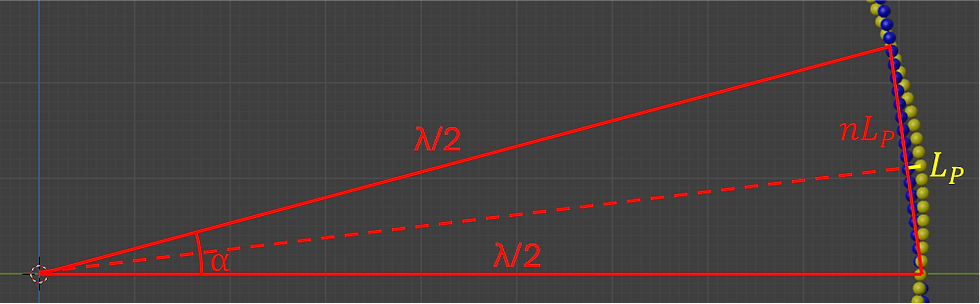
The short answer is you probably can´t. The long answer is: you actually have to take two of the half-circle/half-helix pairs to get a helical circle. This way, the two helices can occupy the same general space, only with a 90-degree offset to each other. In this model, the helix rotates half a turn in a single turn around a circular orbit and a full turn with two turns around a circle:
I´ve yet to combine these two models of half-helical petal-compression and entangled circles together, but this shouldn´t be too hard. I think I will add this model to my quantum gravity paper. But instead of trying to propose that there are elementary particles of energy, I will only propose the shape to be the smallest supramolecular segment that can move in a least sterically confined way. The reason why I don´t want to propose an elementary particle of energy just yet, is that peer reviewers don´t like too many new ideas in a single paper.
So, what is the difference between this particle-wave to the model to the one presented in the rest of the paper? Well, the motion tangential to the helix is for cases where steric confinement is maximal. Conversely, this motion describes less sterically confined motion. In the case of molecules, this motion happens in a local ´molecular vacuum´, or a region where the density of molecules is so small that only some molecules of the entangled circular helix are in direct contact with surrounding molecules. And even then, it is possible that at least for brief periods of time the circular helices can move with no contact with surrounding molecules. And just like in the model presented at the beginning of this post, the molecules move in a rotating helical front. Or as a non-rotating circular front, if the shape happens to move in a true molecular vacuum, where collision with other molecules doesn´t produce a rotational component to the motion.
And why am I so confident that this describes the particle-wave duality? The answer is that for over four years of working on the problem I´ve never before had a model that I´ve been happy with both from a mathematical and a physical perspective. At least I haven´t been happy with them once I´ve started being rigorous in both fields. But this new model doesn´t only make mathematical sense, it also makes physical sense.
Of course, I´d be naïve to say that there is zero chance that my model is incorrect. The only thing I can say is that for a long time I had to omit this part of the theory from my quantum gravity paper, because it was the weakest link. Now, this part of the theory makes perfect sense and will hopefully strengthen the paper, instead of casting doubt over it.
The only tiny problem I have, is that I no longer have the time to work on the paper during my working hours, because I´ve transitioned to working 100 % at LignoSphere, leaving only evenings, weekends and vacations for the manuscript. But I think now that I know what to say, finalizing the manuscript shouldn´t be too hard.
Comments