

The Shaky Motion of Light

In my last post I presented the circular sine-wave model of light and mentioned the wave-particle duality, but in the accompanying animation, my vibrating circular sine-wave was still a single element. However, to properly illustrate this, I knew I needed to actually illustrate the circular sine-wave model of non-connected particles of energy. So, this is that post.
First of all, I think I need to clarify what I mean when I say particles of energy are not connected. There is no force that keeps these particles together. At least not in a fundamental sense. The only reason particles of energy don’t just fly away is that most of their speed is perpendicular to the plane (or the quasi-plane when talking about a circular sine-wave), where there is a small (or at least smaller) component of back-and-forth vibration caused by the refractive index of the medium in which light moves.
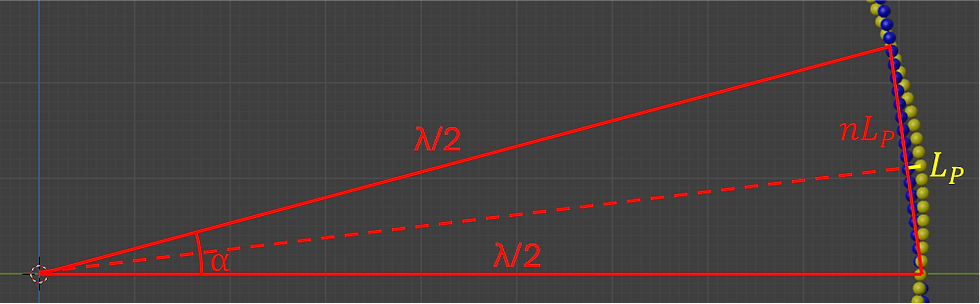
But why the sine wave? Well, the spheres would move in a straight line, if their movement was not confined by collisions with the medium (most often air) in which they move. The ring can only compress into a smaller diameter by creating ‘wrinkles’ into a cylindrical path along which the spheres move. And these wrinkles are described as a sine wave bent into a circle.
Each of these spheres are moving in a quasi-helical (but really a linear) path along the cylindrical surface, but reversing their direction of rotation with every collision, turning the motion that I for a long time thought to be rotational into vibrational motion. This means that at every moment in time half of the spheres are ‘quasi-rotating’ in one direction, while their neighbors are rotating in the opposite direction. Like this:
The only way for me to illustrate this concept is to exaggerate both the size of an individual sphere in relation to the sine-wave circle, and the amplitude of the wave. Although the presented model has an amplitude that is of the scale akin to the motion of light through water or glass. But because of the smallness of the spheres in relation to a single wave, the environment that a single particle of energy sees is almost linear, with minimal curvature at best and truly linear at two points in the wave (because of maths). In one of these linear points the motion of the particle of energy is 100 % along the tangent of the sine wave. When this particle is reflected, it moves perpendicular to the wave. Everywhere else the motion is governed by these two node points and is identical to this perpendicular motion.
I don’t think I’m explaining this concept very well. I think the reason is that while I’ve known the broad concept of helical rotational motion for four years, this new idea of vibrational motion is quite new to me. Or at least it’s new in this relatively concrete manner. I’ve been toying with the idea of vibrational motion for some time, but I’ve never before been too satisfied with it
I would have hoped for the animation for today’s post to be better, but it just seems hard to convey the shaky vibrational motion in a truthful way that still shows the particles and the vibrations. However, the scales of these are too small and too fast to show realistically, so I need to resort to a bit of lies to children. But only the minimum amount necessary.
Once again, I finish with the question: “Is this the final theory?”. The short answer is, it might be, but I need to try to break it for the next days, weeks or months and see whether it holds or not. If it has some major flaw, I’ll probably be able to find it. If it has a minor flaw, it will probably be found in peer review, or at least once the theory is published. I’m not making any promises, but at least this model is the first one that really takes motion of individual particles so seriously that I can animate it.
Comments