

The LignoSphere Cylinder Crystal

In my last post I presented the Waterman-Lintinen Sphere. The sphere is an adaptation of Waterman polyhedra, but applied to the crystallization of (nano)tubules, or short cylinders, into quasi-spheres with a truncated octahedral core. The only issue I had with the model was that I knew it was a simplified version of the true crystallization of lignin nanotubules, lacking certain elements clearly visible in Electron microscopy of the disrupted crystallization of colloidal lignin particles, or LignoSpheres, as we call them in my company.
But today, I’m presenting for the first time the crystal structure of LignoSpheres. The scale is quite accurate, as the model is 50 cylinders high, which translates to a 400 nm sphere, when an individual lignin cylinder (or hollow nanotubule) is about 8 nm in length (and diameter).
So, what are the tricks to making the crystal? Well, first of all we need the obelisk shapes you can see in the electron microscope image, I’ve shown in various posts, but talked more about in the Waterman TIE-Fighter -post:

But if I only show the cylinders as arrays of spheres, this masks the complexity of their crystallization. To really see how difficult it is to crystallize them to the above obelisks, I connect each sphere with a cylinder but only show the outermost spheres on the edges. The slightly comical thing is that when I make the final quasi-spherical model, the intricate detail of these zig-zag pyramid bodies are completely masked by the crust. So here is first the inside of the lignosphere cylinder crystal:
I’ve omitted the truncated octahedron in the center, which I’ve already shown in “The Waterman-Lintinen Sphere” post. However, this time there is only the truncated octahedral core, and the cylindrical sweep comes after the new obelisk-extended truncated octahedral core. In the above model you see some of the other features that remain hidden after the crust is added.
And this is what the lignosphere cylinder crystal looks like with the quasi-spherical cylinder crystal surface:
The curious feature of this model is that when the base is no longer an equilateral hexagon, but an alternating equiangular hexagon, like I describe in “The Octahedral Waterman Seed”.
While the model is mathematically sound, the only objection I have with this model, is that the dimensional ratios of the obelisk are off, with the base of the obelisk being clearly too short. Only in writing this post, I realize that while the outer core of the lignosphere cylinder crystal is indeed a truncated octahedron, it looks very much that the inner core is a cuboctahedron. This shouldn’t change the outer structure at all, but will change the illustration of the inside of the crystal.
It shouldn't take too long for me to adjust the model to match the electron microscopy data. But even now, the model is so close to the true crystallization of LignoSpheres, that I can call the above quasi-sphere as a LignoSphere model.
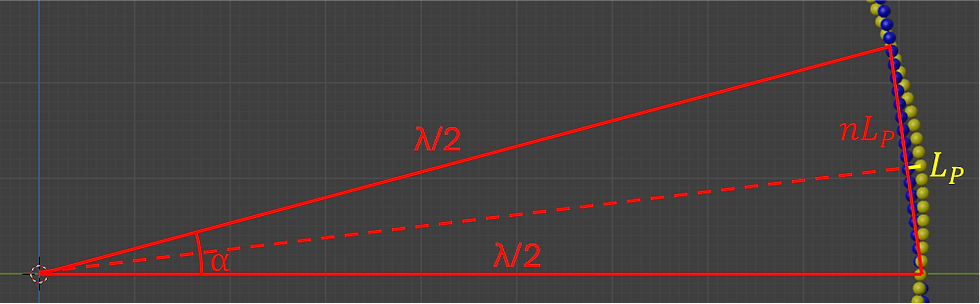
The last slightly comical point here about spheres and quasi-spheres is that I have actually had to define a lignin sphere to the patent office through surface roughness, where the variation of the radius of the sphere is less than a specific percentage. I can no longer remember what the exact percentage was, but I remember calculating it by fitting two circles around electron microscopy images of LignoSpheres, where there is no lignin visible outside of the outer circle and no gaps inside the inner circle. And the rough surface of the LignoSphere being fully located between these two circles.
Comments