

The Waterman-Lintinen Sphere

Today I’m doing something brash. I’m claiming a geometrical shape as my own. The shape in question both is and isn’t a Waterman polyhedron. Or more specifically the notation of a Waterman ‘sphere’ is non-physical and needs to change to be relevant to the crystallization of nanotubules. To begin, I’ll start explaining how a Waterman polyhedron is defined.
According to Wikipedia:
A Waterman polyhedron is created by packing spheres according to the cubic close(st) packing (CCP), also known as the face-centered cubic (fcc) packing, then sweeping away the spheres that are farther from the center than a defined radius, then creating the convex hull of the sphere centers.
The problem in this notation is that the only important spheres are those furthest from the center of the cluster of spheres and all other speres are ignored. This means that all the polyhedron shapes found on the Waterman polyhedron Wikipedia page depicting polygons show the locations of smaller spheres lying on the surface of a larger sphere, hiding rest of the spheres. This means that the emphasis on the shape is placed on the relative locations of the surface spheres and not on the actual crystal planes, or more specifically lattice planes.
So, what is wrong with the Waterman notation? It draws polyhedra between spheres that are not really adjacent to each other. That is, in some of the polyhedra the sphere-to-sphere distance is much, much larger than the diameter of a sphere, while I propose that the only physically feasible lattices are those where the sphere-to-sphere distance is exactly the diameter of a sphere, where the Miller index is (111), and most importantly the lattice is always hexagonal. This means that the only way to draw physically representative spherical polyhedra is not to draw links between surface spheres, but between neighboring spheres on the same plane. While this makes the linked structure much more complex than the one currently depicted for Waterman polyhedra, it doesn’t hide the underlying lattice structure.
In fact, this new notation reveals the truncated octahedral core behind a perfect Waterman polyhedron. Or more specifically, focusing on the (111) planes one can see that a spherical sweep makes much less sense than a cylindrical sweep.
So, what did I find? In playing around with closely packed spheres, I found a way to make an extremely round shape out of spheres with only (111) planes, but where these planes are curved instead of flat. First of all a made a cubic array of close-packed spheres in Blender. Then I rotated the array in a way that arranged the (111) plane perpendicular to one of the main axes. Then I created a cylinder with a radius of the sphere array (here normalized to 1) and with a depth the diameter of the array (normalized to 2). Then I applied a Boolean operation to the array of sphere with the cylinder, sweeping all of the spheres from the array, except those located inside the cylinder. This resulted in a cylindrical array of spheres, where the spheres located on the curved surface of the sphere were still connected to their immediate neighbor, with no ‘broken crystallites’. Here the crystallites can be compared to staves in a barrel.
This still leaves the top and bottom of the cylindrical plane flat, and crystallographically on the square (000) plane. The way to turn a barrel into a sphere is to create multiple curved lattices. By rotating the cylinder by 60°, one can expose a new plane, such as (1-11) or (-111) or (11-1) (I’m still a bit confused about the exact notation, so I’m not sure which exactly it is). After making three such Boolean sweeps with cylinders, one is left with a shape with two quasi-spherical caps that are perfectly sweeped into curved (111) lattices, but with the body that still looks wonky. However, this is not a problem. The caps can be cleaved from the body with similar Boolean sweeps, leaving exactly two eights of the final volume of the final sphere. But while the initial Boolean sweeps were intersecting, leaving the intersecting volume intact this time the sweeps are exacting, removing the volume not belonging to the caps. I won’t bore you with the details, but it’s basically about defining a plane after which the cap is not representative and cutting everything beyond this plane. And when the three cutting planes are perpendicular to each other, the caps can be aligned neatly on the xyz planes, with the volume not crossing between negative and positive values on the plane. After creating one such cap pair, four identical copies are made and rotated around one of the axes by 90°, 180° and 270°, creating a pretty perfect quasi-sphere, like this:
I’m cutting a lot of corners in the explanation, because otherwise this post would be even more complicated than it already is. And when applied to the model of cylinder stacking, this translates to the below shape:
The reason why the above shape isn’t as pretty as the first ‘beach ball model’ is that I first came up with the idea using the cylinder-ball model using trial and error and only after analyzing this shape, I figured out the exact rules on how to make the exact shape. But now that I know how, I’ll be able to make a prettier sphere of cylinders as well.
The only slight squabble I have with this shape is that the shape is a bit bumpy at the corners of the hexagons. But there is a really simple solution: when the corners of the hexagons are removed, one obtains a dodecagon, which is much more circular than a hexagon:

This is indeed a shape that resembles something I have seen in an electron microscopy of lignin crystallization:

Except in the above image the hexagon is even more distorted. Also, the dodecagon doesn’t seem to be uniform but with corner-capping the crystallites seem to be loose.
However, this is how physical chemistry works. Just as the requirement for the formation of hexagonal crystallites was governed by physical constraints, so do more physical constraints require these loose crystallites to exist.
I’m really hoping that I can get this peer reviewed. Unfortunately, based on my previous track record, it will be a serious uphill struggle to get this published.
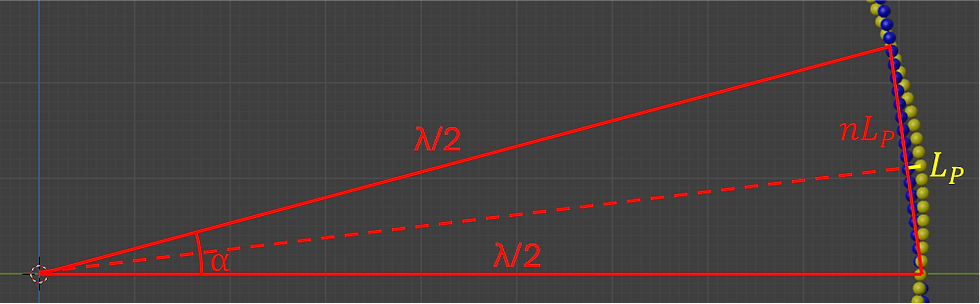
And on a final note: I think I still haven’t explained what the geometry in the Waterman-Lintinen sphere is. The base is the same truncated octahedron as before, but the swelling of the hexagons turns the phase boundaries between the stacked hexagons into very narrow isosceles trapezoids, which in turn stack up to slightly thicker isosceles trapezoids, when the sizes of the steps are identical over multiple steps. Probably the most important thing to note is that while the underlying shape of a sphere of spheres is the same in a Waterman polyhedron and a Waterman-Lintinen polyhedron, the definition of the convex hull is different. While a Waterman polyhedron defines only the spheres exactly at a specific distance from the center, my notations considers all of the spheres belonging to the convex hull, making the shape consists of many more polygons. Or, if Waterman polyhedron is a sphere of spheres, a Waterman-Lintinen sphere is a sphere of cylinders.
Comments